To top-off our air-ground radio training we were fortunate to be invited to visit the Radio Communications tower at Duxford Airport. This was incredibly useful in terms of seeing flight planning, meteorology report passing and tower operations in action. Colin and Peter were most generous with there time and knowledge.
Colin and Pete explained the numerous systems and software they use in the Tower.
One of the scarier sounding jobs I will be doing at Rothera will be submitting formal FPL flight plans into the AFTN terminal for Dash 7 flights. I don’t really know the reason why plans are required for the Dash 7 flights but not the Twin Otter flights. It might be because the Dash weighs more than 5,700 kg, while the Twin Otters weigh less. It was great to see the AFTN software being used at Duxford. Colin gave us a very helpful and thorough walk-through of the coding, submission and updating of a flight plans via the AFTN software. The flight plans are very code heavy messages and at first sight seem quite impenetrable.
Duxford tower operations also pass a lot of meteorological reports to and from pilots. During our visit a Catalina PBY took off and departed up through the cloud ceiling. Colin collected and relayed a meteorology report from the Catalina pilot as he left the airfield.
Colin taking a met report from the Catalina PBY
Colin also took us through the process of decoding, translating and reading out meteorological reports and forecasts from the TAFs and METARs he downloads twice hourly from the Met Office Aviation Briefing Service.
As a radio operator at Rothera Station I will be doing aircraft flight-following. This means that I will be taking regular position and meteorology reports from BAS pilots and in return giving them meteorology reports and any other information they require about the airfields and areas they are flying towards.
In the UK Ofcom are the officialdom custodians of the radio frequencies. For the air band frequencies Ofcom delegate responsibility for training and licencing of operators to the Civil Aviation Authority (CAA). The CAA recognise three levels of ground to air radio service/licence. The highest level is air traffic control (ATC), then flight information service (FISO) and thirdly the much more basic air-ground radio (AGCS). Rothera base offer just the basic air-ground radio service. To operate the radio service at Rothera station it is appropriate for me to hold a CAA AGCS Radio Operators Certificate of Competence. Obtaining this licence involves passing both a written and a practical exam. The theory exam covers all of the material in CAP 452 Aeronautical Radio Station Operators Guide and the sections of CAP 413 Radiotelephony Manual relevant to the air ground radio service and take a practical exam.
BAS run a course each year to train and licence the radio operators for the upcoming season. I spent my first week working for BAS on this course. This was hands-down one of the best training course I have ever attended. Paul is a Senior Air Traffic Controller at Stansted Airport. He has been providing this training for BAS for many years and it shows. The course is very well structured and paced.
The first morning was spent summarising the theory material that ideally you will have self-studied before the course. Then we started talking on the radio.
Paul has a tidy set of kit that he uses to run the practical practice sessions. We students sit in a cubical wearing a headset, we have a PTT button to transmit and the local pressure, wind and circuit information is posted on the booth wall as it would typically be in a radio office. Paul sits outside the booth with a unit connected via a serial cable and pretends to be various aircraft.
The first practicals was a straight forward communication with a single aircraft on the apron preparing to depart. The second practical was also just an single aircraft, this time an incoming aircraft wanting to join the circuit to land.
On the second day of the training Paul started increasing the number of aircraft involved and the types of requests. By the afternoon he had us handling more than five aircraft and responding to a Mayday distress call in amongst it.
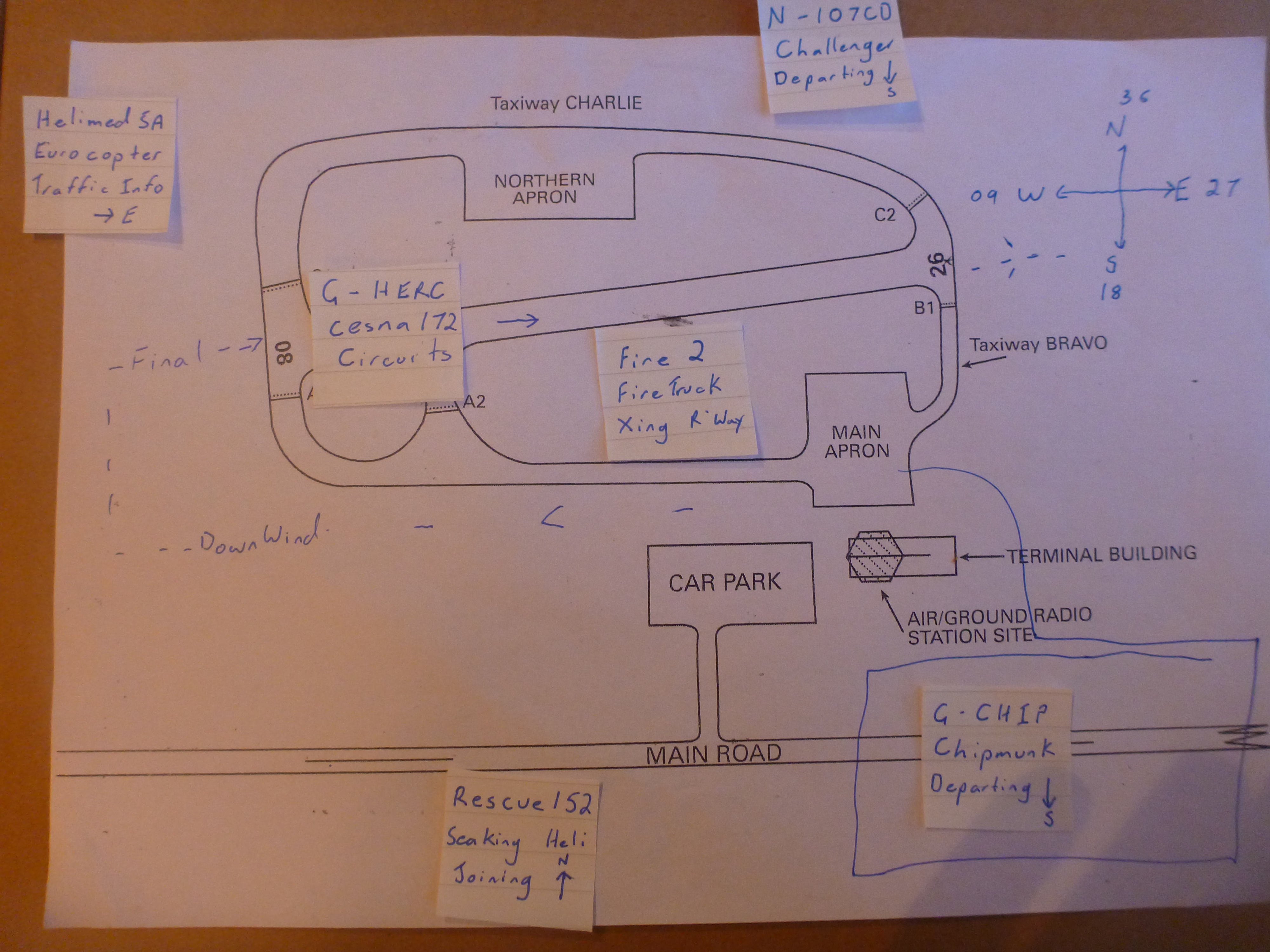
A key piece of information that radio operators pass to aircraft is information about other pertinent traffic in the vicinity. So for example if a pilot reports that they are about to depart the airfield or cross the runway it is useful to tell them if there is another aircraft on final approach to land. Similarly if an aircraft intends to join the circuit to land it is useful to make the pilot aware of any traffic ahead of them in the circuit so they can watch out for it. To do this the radio operator has to keep track of the position of all traffic in the vicinity. It was clear very quickly that I wasn’t going to be able to do this in my head so I designed a system to visually track the traffic. For each new aircraft I would write up a small card contain the aircraft callsign, type, destination and heading, and each time the aircraft reported a new position I would move the card to the appropriate position on a diagram of the airfield.
The third day was practice and refinement of our skills and techniques and an introduction to meteorology reporting(more on met later in a different post).
By Thursday we all felt ready to take our exams. The theory course at 10.00am then the practical in the afternoon. Everyone passed.
Every year around Christmas time the British Antarctic Survey start putting the seasonal job advertisements on the BAS website for the winter teams posts for both the Halley and Rothera bases. I know the annual recruitment cycle for these posts well as for 2 years on-the-trot, despite it being a rather long-shot I have applied for the Wintering Communications Manager posts. Both times I was fortunate enough to get an interview but not lucky enough to get the job.
The interview days were enjoyable enough though, the second year more so than the first year. Partly because I knew better what to expect and partly because they made the interview programme more interactive. The invitation letter said that during the interview I would be asked to present for five minutes about a hobby. The day started with watching a short presentation about BAS and the bases. Then I completed a questionaire with some stock questions about why I wanted the job and what I knew about BAS and what I anticipated it would be like working on an Antarctic base. I was also asked to sign a form confirming that I understood that I would be expected to contribute several hours a week to cleaning, cooking, tidying, bathroom scrubbing and other jobs (GASH). Slightly more randomly I was asked to complete a form providing all my clothing sizes including my glove and hat size before I had even been interviewed.
The interview started with me presenting for 5 minutes on open water swimming. Then the formal interview started which involved a round of questions from each of the three panel members. The questions covered work organisation/prioritisation, team working and cohesion, technical aspects of radio communications and IP networking and a lastly question about my opinion of the BAS alcohol consumption policy.
Next was the medical examination that included a review of my medical history, a good listen to my chest, a step on the scales, a colour blindness check, a check on the warmth of my hands and feet and finally a urine test.
Then the best bit of the day, lunch with the other candidates and the Halley Base Commander. The other candidates were astoundingly lovely and talented so no surprise that after a tortuously long 6 week wait I learned that I had again not been successful.
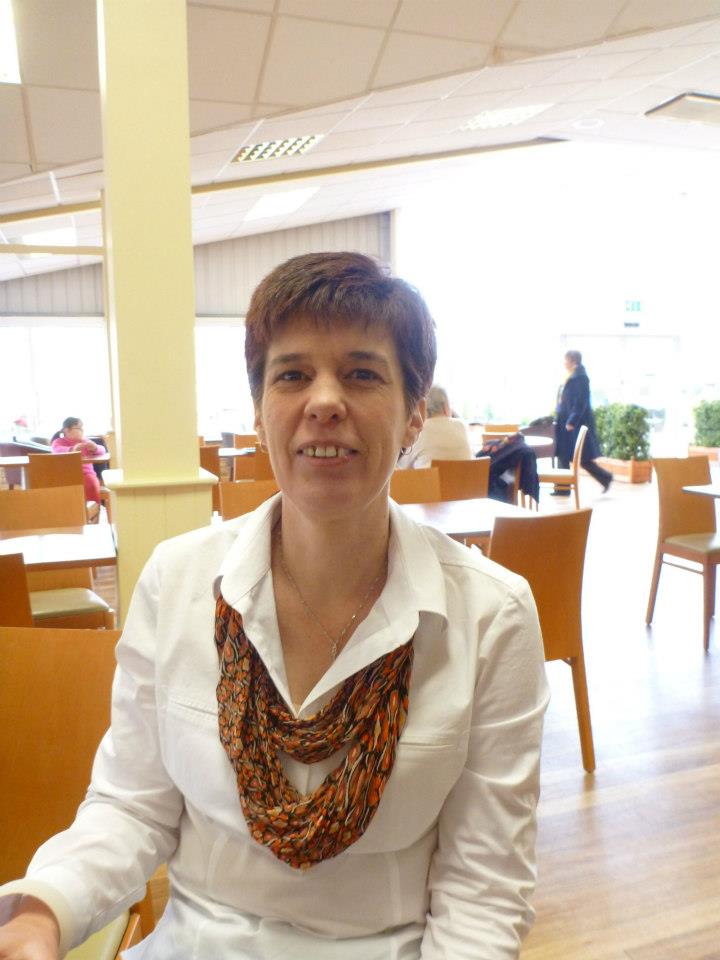
Me feeling very nervous on interview day
However, that wasn’t quite the end of the road for me for the 14/15 season. A few weeks later I got an alternative offer for a summer only job at Rothera base as a radio communications officer. I was stoked. In the ended I was extremely pleased with the way things played out. A summer in the radio tower at Rothera is a very attractive posting which I wouldn’t have gotten if I hadn’t tried for the winter communications manager post. And the summer only posting fits very nicely with plans John and I have been hatching to mountain bike the length of the USA along the Continental Divide next summer.
I started the job at the end of August. September will be mostly training in Cambridge.Then I will get 2 weeks pre-deployment leave at the start of October. And I will leave the UK to travel to Antarctica via Punta Arenas on the 19th of October.
To meet the medical requirements for deployment I have been vaccinated for yellow fever, meningitis, MMR, had a hepatitis booster and visited my dentist to get the BAS dental clearance form signed off.


 Pass Your Message