As a radio operator at Rothera Station I will be doing aircraft flight-following. This means that I will be taking regular position and meteorology reports from BAS pilots and in return giving them meteorology reports and any other information they require about the airfields and areas they are flying towards.
In the UK Ofcom are the officialdom custodians of the radio frequencies. For the air band frequencies Ofcom delegate responsibility for training and licencing of operators to the Civil Aviation Authority (CAA). The CAA recognise three levels of ground to air radio service/licence. The highest level is air traffic control (ATC), then flight information service (FISO) and thirdly the much more basic air-ground radio (AGCS). Rothera base offer just the basic air-ground radio service. To operate the radio service at Rothera station it is appropriate for me to hold a CAA AGCS Radio Operators Certificate of Competence. Obtaining this licence involves passing both a written and a practical exam. The theory exam covers all of the material in CAP 452 Aeronautical Radio Station Operators Guide and the sections of CAP 413 Radiotelephony Manual relevant to the air ground radio service and take a practical exam.
BAS run a course each year to train and licence the radio operators for the upcoming season. I spent my first week working for BAS on this course. This was hands-down one of the best training course I have ever attended. Paul is a Senior Air Traffic Controller at Stansted Airport. He has been providing this training for BAS for many years and it shows. The course is very well structured and paced.
The first morning was spent summarising the theory material that ideally you will have self-studied before the course. Then we started talking on the radio.
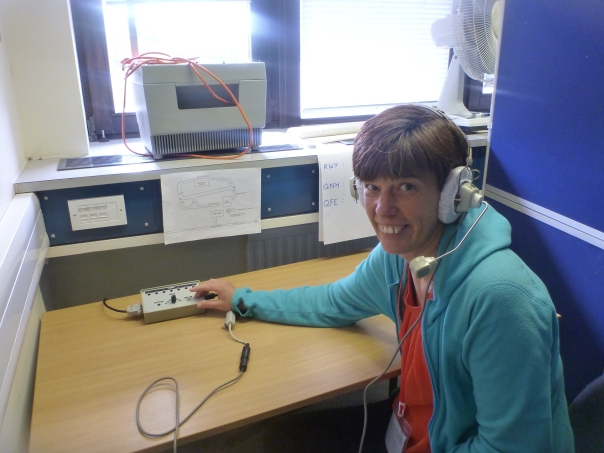
Paul has a tidy set of kit that he uses to run the practical practice sessions. We students sit in a cubical wearing a headset, we have a PTT button to transmit and the local pressure, wind and circuit information is posted on the booth wall as it would typically be in a radio office. Paul sits outside the booth with a unit connected via a serial cable and pretends to be various aircraft.
The first practicals was a straight forward communication with a single aircraft on the apron preparing to depart. The second practical was also just an single aircraft, this time an incoming aircraft wanting to join the circuit to land.
On the second day of the training Paul started increasing the number of aircraft involved and the types of requests. By the afternoon he had us handling more than five aircraft and responding to a Mayday distress call in amongst it.
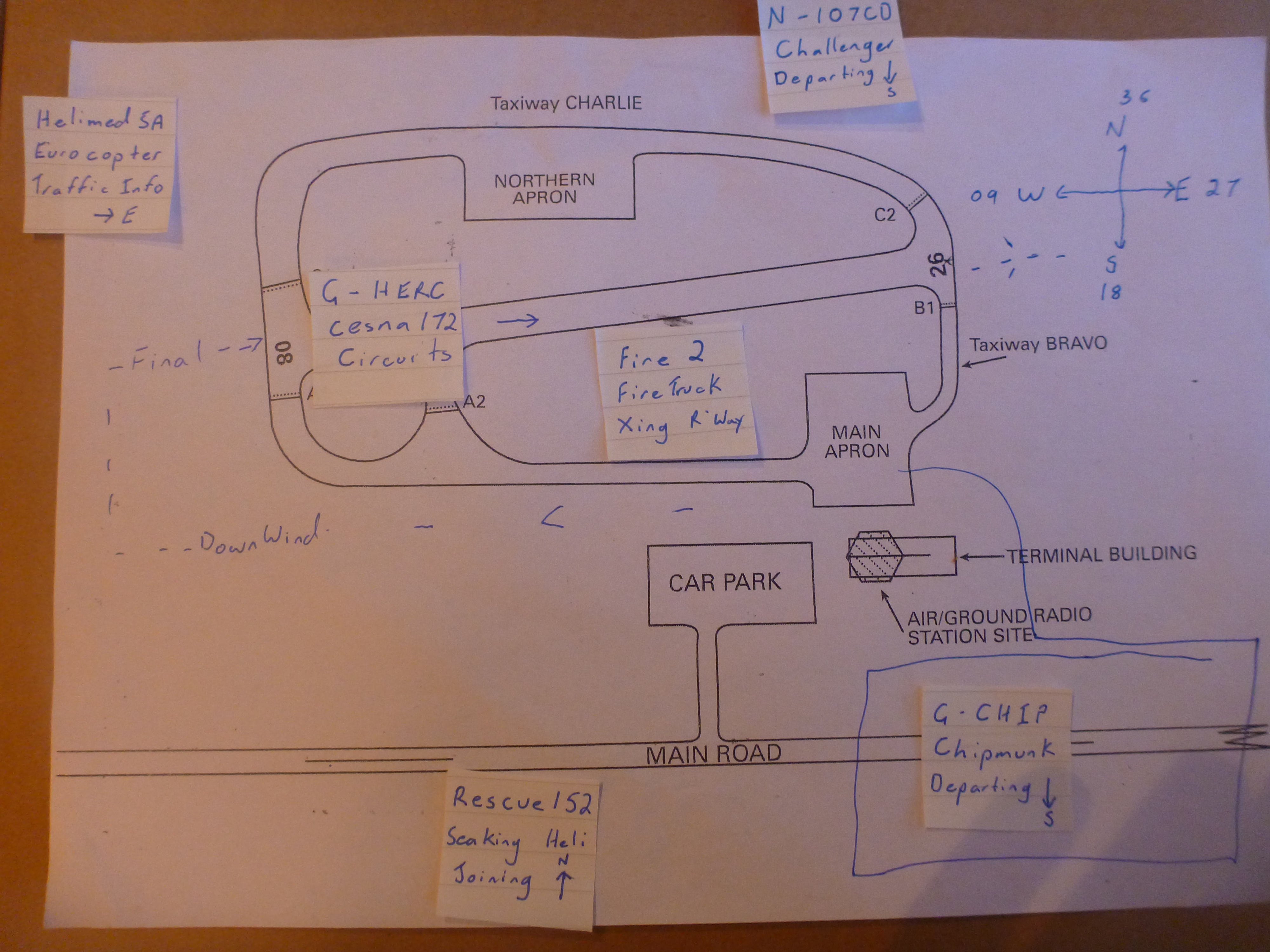
A key piece of information that radio operators pass to aircraft is information about other pertinent traffic in the vicinity. So for example if a pilot reports that they are about to depart the airfield or cross the runway it is useful to tell them if there is another aircraft on final approach to land. Similarly if an aircraft intends to join the circuit to land it is useful to make the pilot aware of any traffic ahead of them in the circuit so they can watch out for it. To do this the radio operator has to keep track of the position of all traffic in the vicinity. It was clear very quickly that I wasn’t going to be able to do this in my head so I designed a system to visually track the traffic. For each new aircraft I would write up a small card contain the aircraft callsign, type, destination and heading, and each time the aircraft reported a new position I would move the card to the appropriate position on a diagram of the airfield.
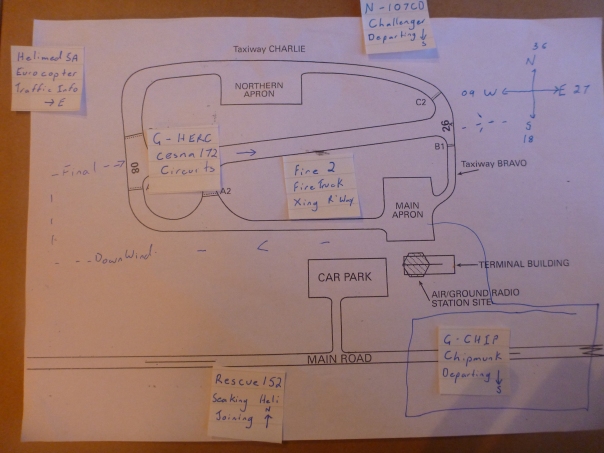
The third day was practice and refinement of our skills and techniques and an introduction to meteorology reporting(more on met later in a different post).
By Thursday we all felt ready to take our exams. The theory course at 10.00am then the practical in the afternoon. Everyone passed.


 Pass Your Message